Research-based knowledge plays a key role in regional development, but its impact is realized when it is translated into real-life decisions, services, or innovations (Pusenius 2026). This process, known as knowledge transfer, is important for higher education institutions (HEIs) and is also a central part of the KnowledgeAnalytics project.
KnowledgeAnalytics is an Interreg Europe project that explores how knowledge transfer can be better identified, measured, and supported in regional innovation systems (LAB 2026). In January 2026, LAB University of Applied Sciences hosted transnational learning activities in Lahti, bringing together project partners from across Europe to examine good practices in Finland and reflect on how knowledge transfer works in real-life contexts.
![[Alt text: sixteen persons smiling in orange reflective vests in front of the wall, in the wall there is the text powering planet cool.]](https://blogit.lab.fi/labfocus/wp-content/uploads/sites/8/2026/02/76_2026_Knowledge-transferred-across-countries-1024x615.jpg)
The two-day programme combined case presentations, peer learning, and on-site study visits. Although data platforms and digital tools were discussed, a common theme emerged across most conversations: effective knowledge transfer occurs through people and everyday interactions, not only through official systems.
When knowledge leaves the desk
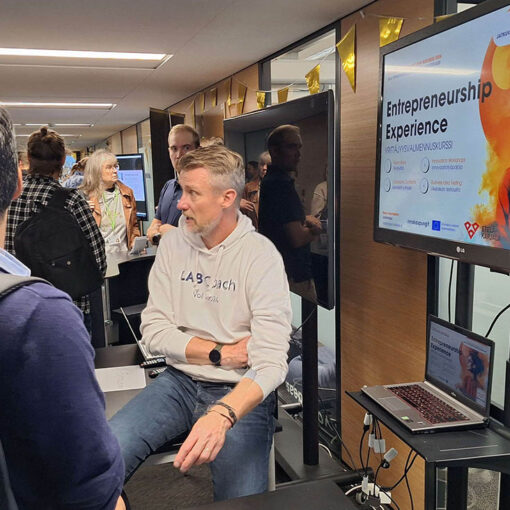
On the first day, we heard insightful presentations on regional perspectives of knowledge transfer from the research.fi platform and LAB’s R2B example. Research.fi makes Finnish research data visible and accessible for policymakers, media, businesses, and the public. On the second day, the study visits in Lahti’s LAB campus offered concrete examples of how research, education, and practice intersect.
The first visit took participants to the Kempower facilities. Kempower is a Finnish company that has rapidly become a global leader in fast charging solutions for electric vehicles. At Kempower, partners explored how close collaboration between industry and research supports rapid innovation in electric mobility. An interesting illustration of this is the joint EMRC (Electric Mobility Research Center) research centre established by LUT University and Kempower. The visit highlighted how shared development environments, applied research, and skills enable research-based knowledge to move efficiently into commercial solutions.
LAB WellTech, StartHub, and Yrityskylä
The second visit explored LAB WellTech and StartHub, two innovation hubs born at LAB. LAB WellTech supports companies developing health and wellbeing technologies, while also offering students testing environments and expert collaboration. StartHub accelerates early-stage business ideas with mentoring, business development advice, and other free services. The visit to LAB WellTech and StartHub showcased how a HEI can act as a platform for co-creation. Companies, researchers, and students collaborate in authentic testing environments, enabling knowledge transfer through joint experimentation, learning, and business development.
The final visit took participants to Yrityskylä, a miniature city where children learn about work, the economy, and society through hands-on simulations. Students take on real roles, earn salaries, pay taxes, and make decisions, experiencing how society functions. This visit expanded the knowledge transfer perspective to future generations. Through a simulated society and work-life environment, children gain a practical understanding of entrepreneurship, work, and civic responsibility, demonstrating that knowledge transfer can also begin at a young age and build long-term capabilities and an innovative culture.
Why knowledge transfer matters
Knowledge transfer is not an abstract concept. It happens when people collaborate, experiment, and apply insights in real contexts (Pusenius 2026). Whether developing fast-charging systems, supporting new businesses, or teaching children how society works, the key lesson is that when applied, knowledge becomes innovation.
By making knowledge transfer visible in concrete settings, the KnowledgeAnalytics project supports the Päijät-Häme region in strengthening innovation capacity, improving policy design, and ensuring that research knowledge creates real societal value.
Authors
Sofia Ramos works as an RDI Specialist for the KnowledgeAnalytics project (LAB 2026) at LAB University of Applied Sciences. She focuses on building bridges between companies and the academic world.
Paula Pusenius, project manager at KnowledgeAnalytics (LAB 2026), works as a researcher at LAB University of Applied Sciences. Her special interest is knowledge management, especially in public sector.
References
LAB. 2026. KnowledgeAnalytics – Advanced analytics for knowledge transfer monitoring and evaluation. Project. LAB University of Applied Sciences. Cited 2 Feb 2026. Available at https://lab.fi/en/project/knowledgeanalytics-advanced-analytics-knowledge-transfer-monitoring-and-evaluation
Pusenius, P. 2026. Korkeakoulujen kolmas tehtävä – yhteiskunnallinen vaikuttavuus tutkimustiedon kautta. LAB Pro. Cited 9 Feb 2026. Available at https://www.labopen.fi/lab-pro/korkeakoulujen-kolmas-tehtava-yhteiskunnallinen-vaikuttavuus-tutkimustiedon-kautta/