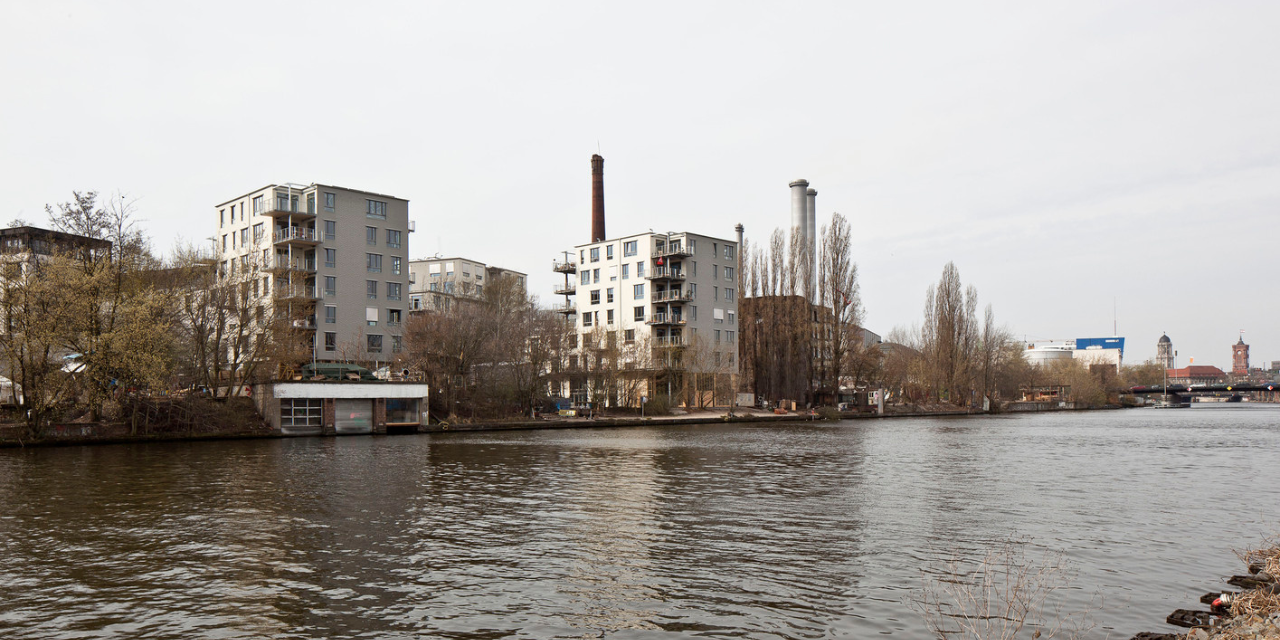
We have exceeded seven of the nine planetary boundaries (Stockholm Resilience Center 2025). Climate change, biodiversity loss, and increasing social inequality challenge us to rethink our assumptions and ways of acting.
Innovation is a novel, implemented, and value‑creating solution that, at best, can transform entire sectors. In an era of wicked problems, innovations must generate not only economic value but also social and ecological value. Innovation may maintain existing structures or renew an industry and its underlying worldview. Regenerative innovations aim for transformative change (Wahl 2022, 58–59).
Regenerative design refers to vitality‑enhancing co‑creation that seeks to systemically restore and strengthen the resilience and well‑being of people, the environment, and the whole planet. Nature serves as a source of inspiration for designing new solutions (Mang & Reed 2012). Regenerative thinking does not strive for quick wins but for enduring value and long‑term flourishing.

Design as an enabler of positive change
Regenerative design is a development approach aimed at enabling positive change, applicable across all sectors when new solutions are being created. The roles of design and designers are evolving (Design Council 2026). As planetary boundaries are being exceeded, the role of design has expanded from human‑centred approaches toward planet‑centred development, and from shaping experiences to generating broader systemic impact. The designer becomes a change agent and facilitator who helps to dissolve dysfunctional practices, enable transformation, and support the development and embedding of new ways of operating.
The phases and iterative nature of the design process are equally central in the co‑creation of regenerative innovations: systemically exploring, deepening understanding, generating ideas, prototyping systematically, and scaling what works. Design is inherently participatory, creative, and future‑oriented. In addition to a planet‑centred perspective, it considers human needs, the benefits of technology, and the viability of business.
Regenerative organic innovation as an enabler of urban greening
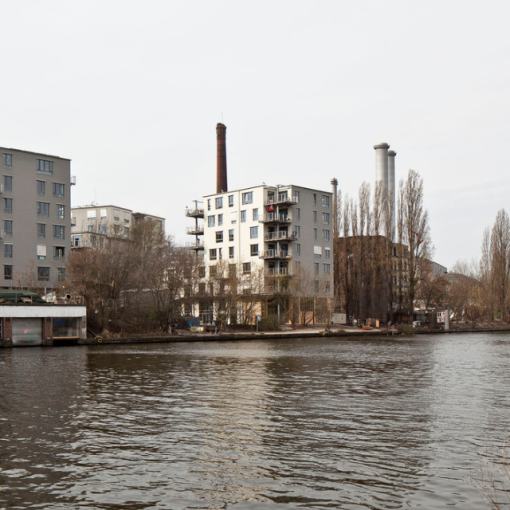
Urban greening helps mitigate summer heat stress, and planted areas also support stormwater management, particularly on rooftops. Increasing vegetation enhances oxygen production and functions as a carbon sink, like moss in particular has been shown to remove impurities from the air. Vegetable roofs can retain up to 70 percent of stormwater, and remaining runoff can be slowed through complementary solutions such as vertical greenery, permeable stones, and retention basins. Vertical cultivation, including living plant walls, represents one future opportunity for increasing urban vegetation. Urban green infrastructure creates its own micro‑environment that benefits multiple species. Plants produce oxygen, cool urban air, and enhance well‑being. Organic aesthetics soften the urban landscape and promote nature‑positivity.
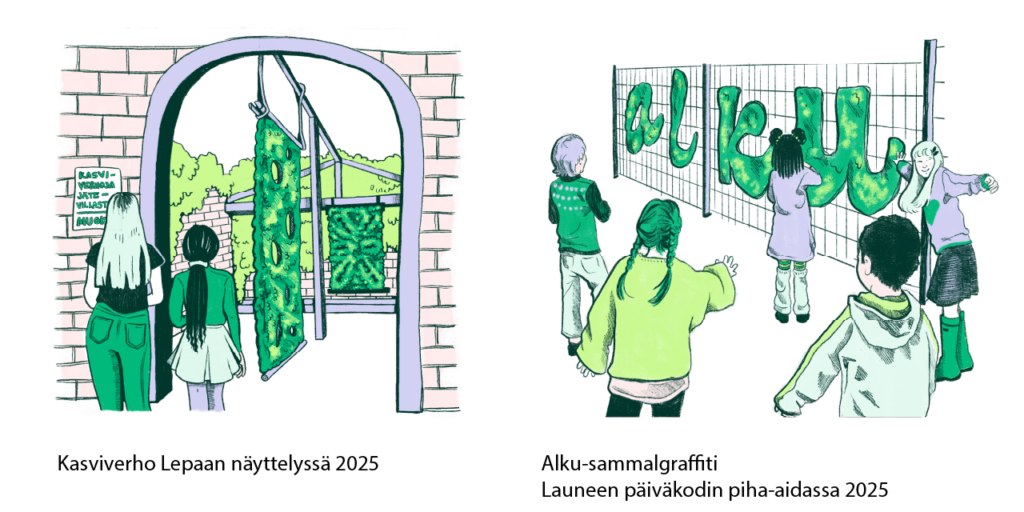
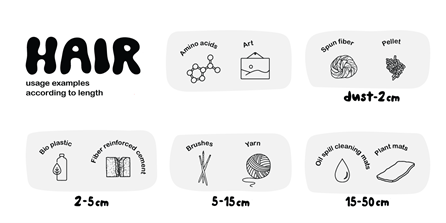
These solutions were developed during the MUOKS project at LAB University of Applied Sciences in collaboration with companies and the wider community. The development process examined the urban environment through design thinking and regenerative design. Currently, geotextiles and absorbent mats used in urban greening are predominantly plastic‑based. To replace plastic, a new alternative was innovated by utilising organic recycled fibres. The organic growth substrate mat incorporated recycled wool and cotton. Wool has been shown to be a suitable material for green infrastructure, while cotton is the most effective organic fibre for retaining moisture. Wool, as a keratin‑based fibre, has strong absorption capacity and durability (Begum et al. 2021).
The development activities exemplify the principles of regenerative design, where local, concrete experimentation and actions taken to benefit the environment form part of a broader systemic solution. Regeneration is a process, and sustainability emerges as its outcome. Our mindset shapes how we perceive the world; our actions shape the environment, and the environment shapes our thinking (Loopconsulting 2018). The process focuses on capacities. Identifying and leveraging the potential of places, materials, and people in ways that influence systems by serving communities and life (Wahl 2024).
Key capacities in regenerative design include creativity, empathy, courage, and passion.
Authors
Paula Nurminen (Designer, Master of Culture and Arts) works at the LAB University of Applied Sciences’ Faculty of Design as a junior researcher in the Design for Futures research group, focusing on regenerative innovation processes. She is also a member of the organizing committee for the SCSR2026 conference.
Eija Pimiä (Designer, Master of Culture and Arts) is an experienced development specialist. She is currently delving into regenerative thinking and the development of future-resilient business.
References
Begum, H., Tanni, T. & Shahid, M. 2021. Analysis of Water Absorption of Different Natural Fibers. Journal of Textile Science and Technology. Vol 7, No 4. 152–160. Cited 9 Feb 2026. Available at https://doi.org/10.4236/jtst.2021.74013
Design Council. 2026. Design for Planet. Cited 8 Feb 2026. Available at https://www.designcouncil.org.uk/design-for-planet/
Loopconsulting. 2018. Systems Thinking and Systems Modelling. Cited 8 Feb 2026. Available at https://loopsconsulting.kumu.io/systems-thinking-and-systems-modelling
Mang, P. & Reed, B. Regenerative Development and Design. Encyclopedia Sustainability Science & Technology, Chapter 303. Cited 10 Feb 2026. Available at https://regenesisgroup.com/wp-content/uploads/2015/02/Encylopedia_Sustainability_Science_Ch303.pdf
Nurminen, P., Koistinen, M., Apajalahti, S., Tanskanen, C. & Pirttijärvi, P. 2025. Elävä kaupunki – Toimintamalli kaupungin luontopositiiviseen viherrakentamiseen. Lahti: LAB University of Applied Sciences. Cited 18 Feb 2026. Available at https://urn.fi/URN:ISBN:978-951-827-513-1
Stockholm Resilience Center. 2025. Planetary boundaries. Cited 8 Feb 2026. Available at https://www.stockholmresilience.org/research/planetary-boundaries.html
Wahl, D. 2022. Designing Regenerative Cultures. Dorset: Triarchy Press.
Wahl, D. 2024. Master Class, Regenerative Design. RCA x Design for Good Academy Masterclass talk: Design as a Regenerative Practice. Royal College of Art. YouTube video 6.3.2024. Cited 10 Feb 2026. Available at https://www.youtube.com/watch?v=-YBxX1nCRf0