Recent data shows that founder wellbeing is a core business risk. The Federation of Finnish Entrepreneurs reports that business owners’ ability to cope has declined since spring 2024. Fewer feel they are coping well, and more report being over-stressed. Even though nearly half of SME entrepreneurs say their wellbeing directly impacts company operations, only about 13% have sought help, and 7% report having no one to turn to (Suomen Yrittäjät 2026). Surveys of startup founders also reveal high levels of stress, anxiety, and burnout, with many leaders concealing their struggles and delaying professional support (Startup Snapshot 2024).
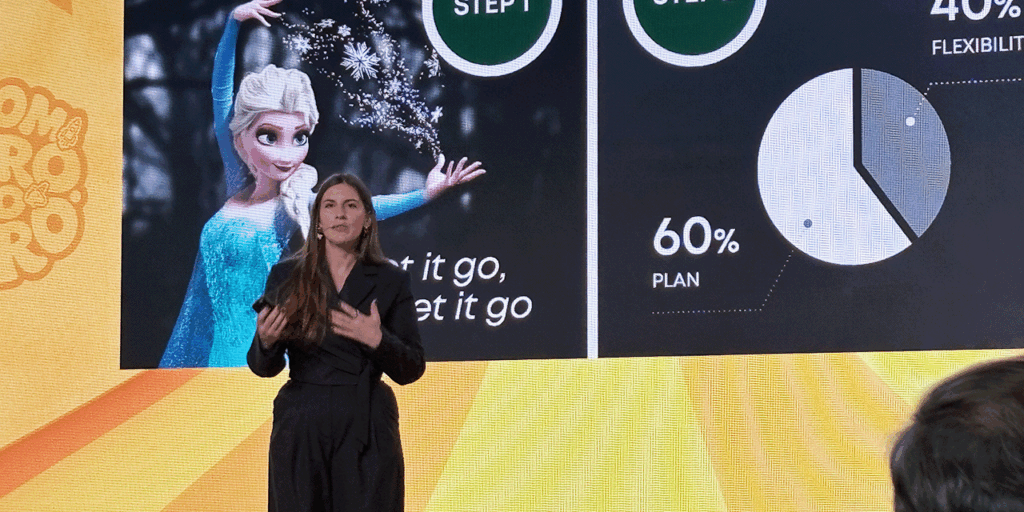
Speaking at the sTARTUP Day 2026 Conference in Tartu, Estonia, Julia Bialetska, co-founder and CEO of S.Lab, a startup developing eco-friendly packaging alternatives to polystyrene, placed wellbeing at the core of company structure, strategy, and organisational design. Bialetska, the winner of the EIT Women Leadership Prize in 2024 (EIC 2024), argued that founders should intentionally organise work to support both sustainable performance and human limits from day one.
Plan for survival and success
Bialetska (2026) described leaders’ life as being on different missions at hardest level at the same time. Fundraising, product development, hiring, planning, and daily operations rarely occur sequentially. As only a minority of seed-stage startups reach a self-sustaining A-level, with each stage eliminating more teams, founders are left with limited time to build the business between funding rounds (Teare 2025). Bialetska views funding is ultimately about buying time, and how that time is used is a strategic decision.
One practical implication is to treat focus as a wellbeing tool. Bialetska’s S.Lab sets only a few strategic goals per year and links them to clear objectives and performance indicators, while consciously declining activities that do not contribute to these priorities. Doing so reduces cognitive overload. Bialetska recommends planning only around 60% of the time and leaving 40% unbooked for unexpected issues and strategic thinking. (Bialetska 2026)
A company’s approach to customers also affects the founder’s workload. S.Lab began with “quick and dirty” prototypes and followed principles from Rob Fitzpatrick’s book The Mom Test. Fitzpatrick (2013) argues that early customer conversations are only useful if they focus on concrete facts about customers’ real behaviour and problems, rather than on their opinions about the business idea. He suggests asking about the customer’s life and listening far more than talking, so that feedback genuinely helps validate or change the business concept. For S.Lab, the approach generated demand before scalable production was in place, creating both profit opportunities and additional pressure to deliver (Bialetska 2026).
Shared responsibility for resilience
Bialetska (2026) notes that the greatest emotional challenge is often managing people and the responsibility of employing them. Founders regularly face decisions that directly impact employees and their families. When founders overextend themselves, the entire organisation becomes more vulnerable.
Bialetska recommends moving from a founder-centred, horizontal organisational structure to one in which team members develop their own strategies aligned with company goals. For her, responsible leadership begins with emotional intelligence: understanding motivation, supporting development, and granting autonomy without overwhelming staff. This approach distributes pressure more evenly, which is important since founder stress often leads to burnout and anxiety, impacting the bottom line (Startup Snapshot 2024; Startup Snapshot 2025; Suomen Yrittäjät 2026). Instead of directly managing an expanding team, Bialetska now works through a smaller group of task leaders, allowing space for fundraising, key customers, and technology decisions.
Bialetska (2026) also emphasises the importance normalising seeking support and setting personal boundaries and activities, such as sleep, nutrition, exercise, and music, that help founders maintain an identity beyond their business role. This directly affects performance, as studies show that poor sleep and chronic stress impair decision-making, especially when startups require clear, timely choices (Startup Snapshot 2024).
Author
Ari Hautaniemi works as an RDI Specialist at the LAB University of Applied Sciences Institute of Design and Fine Arts Design. He is the project manager of CDG-Booster, an Interreg Central Baltic project supporting creative digital companies in reaching growth.
References
Bialetska, J. 2026. The Founder Reality: What We Think Will Be Hard and What Actually Is. Keynote at sTARTUp Day 2026, Tartu, 29 Jan 2026.
EIC. 2024. EU Prize for Women Innovators 2023‑24: the winners. European Innovation Council. Cited 18 Mar 2026. Available at https://eic.ec.europa.eu/eic-prizes/european-prize-women-innovators-powered-eic-eit/eu-prize-women-innovators-2023-24-winners_en
Fitzpatrick, R. 2013. The Mom Test: How to Talk to Customers & Learn if Your Business is a Good Idea When Everyone is Lying to You. London: CreateSpace. Cited 18 Mar 2026.
Startup Snapshot. 2024. The Untold Toll: The Impact of Stress on the Well‑Being of Startup Founders and CEOs. Cited 18 Mar 2026. Available at https://www.startupsnapshot.com/research/the-untold-toll-the-impact-of-stress-on-the-well-being-of-startup-founders-and-ceos/
Startup Snapshot. 2025. Why Are Startup Employees Burning Out Faster Than Founders? Cited 18 Mar 2026. Available at https://www.startupsnapshot.com/startup-employees-burnout/
Suomen Yrittäjät. 2026. Yrittäjien jaksaminen heikentynyt – apua haetaan, mutta moni jää yksin. Cited 18 Mar 2026. Available at https://www.sttinfo.fi/tiedote/71758520/yrittajien-jaksaminen-heikentynyt-apua-haetaan-mutta-moni-jaa-yksin
Szathmári, E., Varga, Z., Molnár, A., Németh, G., Szabó, Z.P. & Kiss, O.E. 2024. Why do startups fail? A core competency deficit model. Frontiers in Psychology. 15:1299135. Cited 18 Mar 2026. Available at https://doi.org/10.3389/fpsyg.2024.1299135
Teare, G. 2025. Far Fewer Seed-Stage Startups Are Graduating To Series A – Raising The Risk Of Failure. Crunchbase News. Cited 19 Mar 2026. Available at https://news.crunchbase.com/seed/funding-startups-timeline-series-a-venture/