Startup post-mortems show most companies fail not because of weak technology, but because they lack a real market, run out of cash, or rely on flawed business models. Recurring issues such as a lack of market need, team challenges, and insufficient focus highlight that mindset and execution are as important as ideas (CB Insights 2026; Agarval 2025; Szathmári et al. 2024; Siswanto et al. 2025). These themes shaped this year’s sTARTUp Day 2026 in Tartu, Estonia’s largest startup conference, where presentations examined what founders often underestimate or overlook in their strategies (sTARTUp Day 2026; Ursache 2026; Ahl et al. 2026).
Money talks – or at least it should
In his talk, serial entrepreneur and MIT Bootcamps coach Marius Ursache argued that innovation leads to success through commercialisation. He noted that popular methods like “design thinking” and “lean startup” can keep teams focused on ideas and experiments without a clear path to revenue. As an alternative, he introduced the 24-step Disciplined Entrepreneurship methodology from MIT. Startups should first select a single, well-defined initial market segment to establish a foothold, generate revenue, and validate their concept. Next steps are expanding to broader markets, defining a measurable value proposition, and identifying key decision-makers in B2B sales (Ursache 2026; Disciplined Entrepreneurship 2024). Ultimately, generating revenue should remain the primary focus.
For science-based and deep-tech teams, a startup is not just an app, a patent, or a lab result; it is a business that must link technical excellence to customer value. Drawing on a 10-year study of MIT’s Delta V Accelerator, he noted that about two-thirds of teams following the Disciplined Entrepreneurship model raised external funding and roughly 60–70% became real companies that either still exist or have been acquired, far above typical startup survival rates. (Ursache 2026; CB Insights 2026; MIT Martin Trust Center for Entrepreneurship 2026). In RDI projects seeking to boost company growth, this underscores the importance of structured commercialisation skills.
Coachability is key
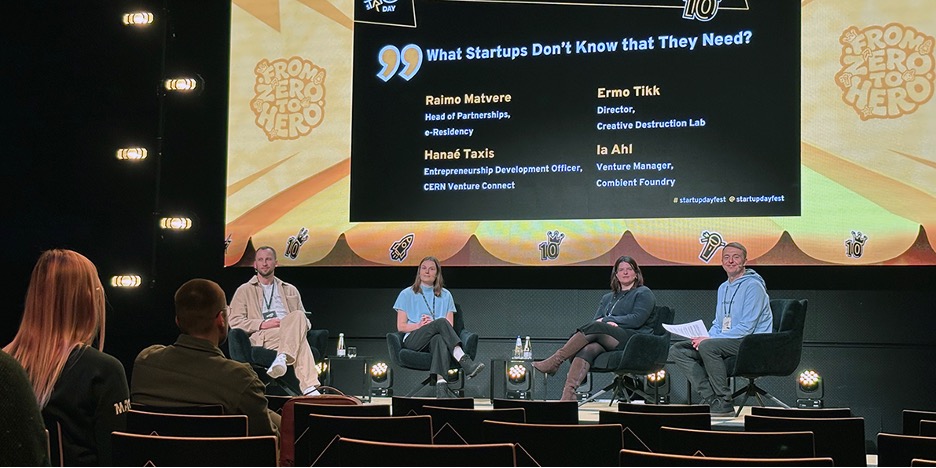
Ursache’s thoughts were echoed in a panel titled What Startups Don’t Know that They Need, in which Hanaé Taxis (entrepreneurship development officer, CERN Venture Connect), Ermo Tikk (director, Creative Destruction Lab), Ia Ahl (venture manager, Combient Foundry), and Raimo Matvere (head of partnerships, e-Residency) discussed common early-stage pitfalls based on their experiences in mentoring businesses. Panellists agreed that mindset is critical: the main challenge is not a lack of available tools, but how founders apply them (Ahl et al. 2026). The most successful teams look for and embrace direct, sometimes painfully frank feedback from mentors and are willing to revise their plans rather than defend initial assumptions (Ahl et al. 2026).
For deep-tech founders, a common pitfall is prioritising technology over the actual problem the business idea should address (Ahl et al. 2026). Being “5% better” than competitors is irrelevant if customers do not understand or value the solution, a trend also seen in broader analyses of startup failure (CB Insights 2026; Szathmári et al. 2024; Siswanto et al. 2025). Their advice is to focus on the problem: discuss the project outside your field, invite co-founders with business expertise, and stay flexible to pivot product and market as needed (Ahl et al. 2026).
Panellists also emphasised the importance of people skills, which are often lacking. Startup founders sometimes dominate meetings with their own insights, missing the chance to identify real pain points of corporate or client stakeholders. Teams that listen, prepare thoroughly, and focus on key objectives benefit most from mentoring. (Ahl et al. 2026).
Tech startups need discipline, focus, and coachability more than additional tools, methods, or canvases (Ursache 2026; Ahl et al. 2026). For universities and startup ecosystems, integrating these mindsets into education and support services can significantly enhance the real-world impact of innovation.
Author
Ari Hautaniemi works as an RDI Specialist at the LAB University of Applied Sciences Institute of Design and Fine Arts. He is the project manager of CDG-Booster, an Interreg Central Baltic project supporting creative digital companies in reaching growth.
References
Ahl, I., Taxis, H. & Tikk, E. 2026. What Startups Don’t Know that They Need? Panel discussion moderated by R. Matvere at sTARTUp Day 2026, Tartu, 29 Jan 2026.
CB Insights. 2026. Why Startups Fail: Top 9 Reasons. Cited 11 Mar 2026. Available at https://www.cbinsights.com/research/report/startup-failure-reasons-top
Disciplined Entrepreneurship. 2024. The Framework (Disciplined Entrepreneurship). Cited 11 Mar 2026. Available at https://www.d-eship.com/about/framework/
Agarval, P. 2025. Why Startups Fail: Top 10 Reasons & Failure Rate Statistics. Cited 11 Mar 2026. Available at https://eximiusvc.com/blogs/why-startups-fail-top-10-reasons-failure-rate
MIT Martin Trust Center for Entrepreneurship. 2026. 10 Years of delta v – Impact Study. Cited 12 Mar 2026. Available at https://entrepreneurship.mit.edu/delta-v-10-year-study/
Siswanto, L.Z., Hartawan, N.L.K.T.S.K.S., Nur, M.R., Tamuliko, I.V., Fadillah, B.F. & Rahman, M.F.W. 2025. Failure Factors of Early‑Stage Digital Startups: A Literature Review. In: Proceedings of the International Conference on Business, Information Technology and Innovation (ICONBIT). Cited 11 Mar 2026. Available at https://proceeding.unesa.ac.id/index.php/iconbit/article/download/5690/1453
sTARTUp Day. 2026. Schedule – sTARTUp Day 2026. Tartu: sTARTUp Day. Cited 11 Mar 2026. Available at https://www.startupday.ee/program/schedule
Szathmári, E., Varga, Z., Molnár, A., Németh, G., Szabó, Z.P. & Kiss, O.E. 2024. Why do startups fail? A core competency deficit model. Frontiers in Psychology. 15:1299135. https://doi.org/10.3389/fpsyg.2024.1299135
Ursache, M. 2026. Disciplined Entrepreneurship—A Framework and Mindset for Innovation‑Driven Companies. Conference presentation at sTARTUp Day 2026, Tartu, 30 Jan 2026.