Small and medium-sized enterprises (SMEs) are essential for Europe’s economy and play an important role in the transition towards climate neutrality. At the same time, many SMEs find climate actions difficult because they lack time, resources, and clear guidance. European policies recognise that cities and regions are key enablers of SME climate action, as they are closest to businesses and responsible for turning EU climate goals into practical local measures and support services. (European Commission 2024; Hampton et al. 2023.)
CLIBUS – Runway to carbon neutrality – Involvement of business communities in climate strategies project is an Interreg Europe project that brings together regions from Finland, Denmark, Greece, Ukraine, and the Netherlands. The project focuses on improving regional policies that support SMEs in climate and energy actions.
From regional discussions to joint analysis
As part of the CLIBUS activities, project partners focused on local business networks and public–private cooperation. Each partner organised regional stakeholder discussions to identify key challenges for SME climate and energy action and to explore how existing networks and cooperation could help overcome these barriers.
The regional results were presented at the 2nd CLIBUS interregional event in Hillerød, Denmark, and then grouped into common themes. Partners were asked to reflect on these themes by identifying the three most relevant shared challenges and opportunities for their regions. The purpose of the joint analysis was not to repeat the regional answers, but to highlight similarities, consider whether any elements were missing, and jointly interpret the findings from a policy perspective. For example, partners identified shared challenges such as fragmented SME support and limited capacity, and opportunities like embedded expert support. Attention was given to how key challenges could be transformed into opportunities for policy improvements, which is a core objective of the CLIBUS project.
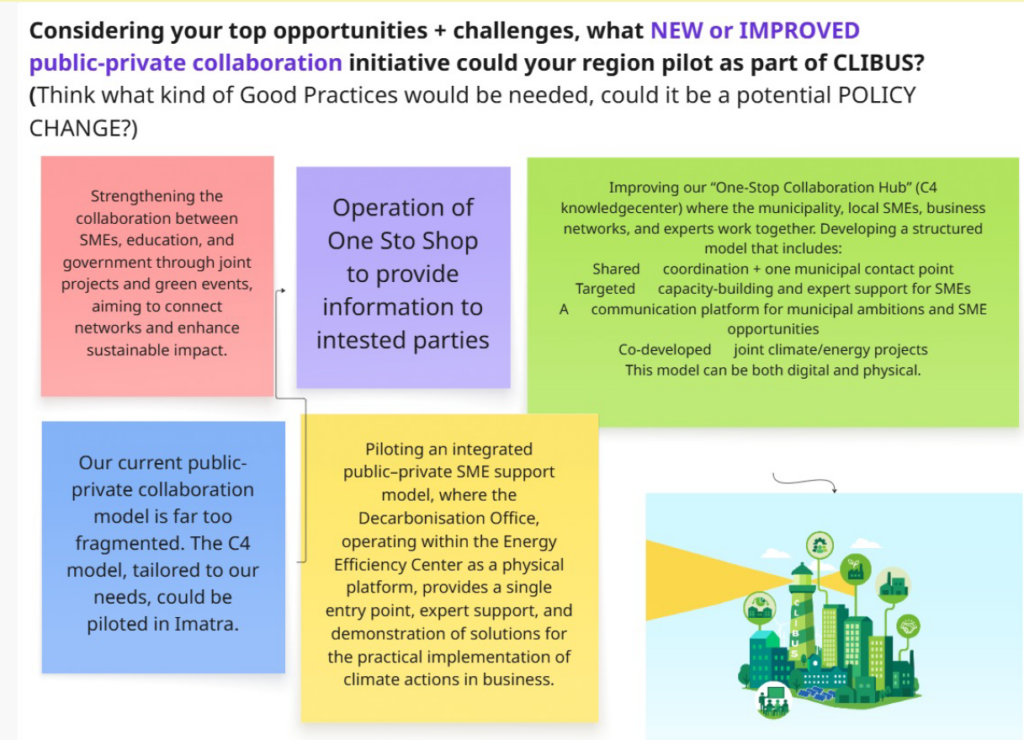
As a final step, partners were asked to identify new or improved public–private collaboration initiatives that could be piloted in their regions to address their most relevant challenges and opportunities. This included exploring the transfer of good practices, as well as drawing inspiration from expert speakers or site visits offered by other project partners. This approach reflects the core idea of CLIBUS interregional events – to learn from local solutions in different regions and use them as inspiration for improving policies at home.
Link to the CLIBUS Good practices
Common challenges and opportunities across regions
Even though the regions are different, they face the same problems. Based on the experiences collected by CLIBUS project partners through their ongoing work with SMEs and related stakeholder engagement, many SMEs see climate action as extra work and focus first on daily business needs (all partners). Support for SMEs is often unclear and spread across many organisations, so it is hard to know where to start (all partners). SMEs also lack time and capacity to take action (FI, DK, UA, NL). In addition, information is often confusing or too technical (FI, UA, NL). These problems appear in many regions, which shows they are system‑level challenges, not isolated local issues.
Across regions, the most relevant opportunities were identified in using business networks more actively to share information and experiences, providing expert support that helps SMEs step by step, showing concrete examples and business cases from other SMEs, and encouraging joint projects where SMEs learn by doing. A key shared insight was simple – more information alone does not solve the problem. SMEs need practical, clear, and coordinated support that fits their everyday business reality.
One of the most important moments in the joint analysis was when partners realised that many regional answers were describing different parts of the same challenge. Fragmented support, lack of capacity and information overload are closely linked.
Final reflections
The CLIBUS joint analysis highlights a few clear messages for cities and regions. Many support tools already exist, but they need to be better organised from the SME perspective. Climate action should be part of normal business support, with clear roles and cooperation between municipalities, experts, networks and SMEs. The strong similarities across regions show that policy solutions can be adapted and transferred. By working together and learning from each other, regions can develop clearer structures and more practical support, helping SMEs integrate climate action into everyday business life rather than seeing it as an extra burden.
Author
Katerina Medkova works as an RDI Specialist at LAB University of Applied Sciences and is CLIBUS Project Manager. CLIBUS – Runway to carbon neutrality – Involvement of business communities in climate strategies is an Interreg Europe co-funded project led by LAB University of Applied Sciences, Finland. The CLIBUS partnership consists of six partners from Finland (2 partners), Denmark, Greece, Ukraine, and the Netherlands.
References
Blomkvist, M. 2020. Team Having a Meeting. Pexels. Cited 22 Apr 2026. Available at https://www.pexels.com/photo/team-having-a-meeting-6476254/
European Commission. 2026. Local and regional climate action: Spearheading a climate-neutral future with Europe’s towns, cities and regions. Cited 11 Apr 2026. Available at https://climate.ec.europa.eu/eu-action/local-and-regional-climate-action_en
Hampton, S., Blundel, R., Eadson, W., Northall, P. and Sugar, K. 2023. Crisis and opportunity: Transforming climate governance for SMEs. Global Environmental Change. Vol. 82, 102707. Cited 11 Apr 2026. Available at https://oro.open.ac.uk/89554/
Interreg Europe. 2025. CLIBUS – Runway to carbon neutrality – Involvement of business communities in climate strategies. Cited 9 Apr 2026. Available at https://www.interregeurope.eu/clibus
Links
Link 1. Interreg Europe. 2025. Project Summary. CLIBUS. Cited 9 Apr 2026. Available at https://www.interregeurope.eu/clibus
Link 2. Interreg Europe. 2025. Good practices. CLIBUS. Cited 22 Apr 2026. Available at https://www.interregeurope.eu/clibus/good-practices
Link 3. Interreg Europe. 2026. 2nd CLIBUS Interregional Event held in Hillerød, Denmark. CLIBUS. Cited 22 Apr 2026. Available at https://www.interregeurope.eu/clibus/news-and-events/news/2nd-clibus-interregional-event-held-in-hillerod-denmark