CC Art Festival is a multicultural and multidisciplinary Blended Intensive Programme (BIP) for business and design students from LAB University of Applied Sciences, BFI Vienna University of Applied Sciences, UCLL University of Applied Sciences, and Heilbronn University. The short-term exchange programme is funded by the European Union’s Erasmus+ programme. This year, the programme took place in Leuven—the very place where it all started four years ago. (Orpana & Saros 2022.)
The overall objective of the BIP is clear: to create a meaningful and positive international learning experience in a blended learning context. The course is not focused on theory alone; rather, it emphasizes real collaboration, shared responsibility, and tangible outcomes.
The core objective of the course is to design, plan, and execute an artistic event as part of a multidisciplinary and multinational team. Students work in mixed groups that combine business and design perspectives, learning to navigate different professional mindsets, work cultures, and communication styles. As a result, the CC Art Festival is implemented entirely by the students themselves.
From planning to implementation
The course begins with six online sessions, each aligned with the intended learning outcomes. During the first three sessions, the focus is on team building and idea development, guiding each team to operate as a cohesive unit.
In the second week, student teams are divided into three thematic focus areas: project management, service design, and marketing communications. This phase marks the transition to concrete project planning, with particular emphasis on service design (how the event is created) and marketing communications (how the event is presented and communicated to the target audience).
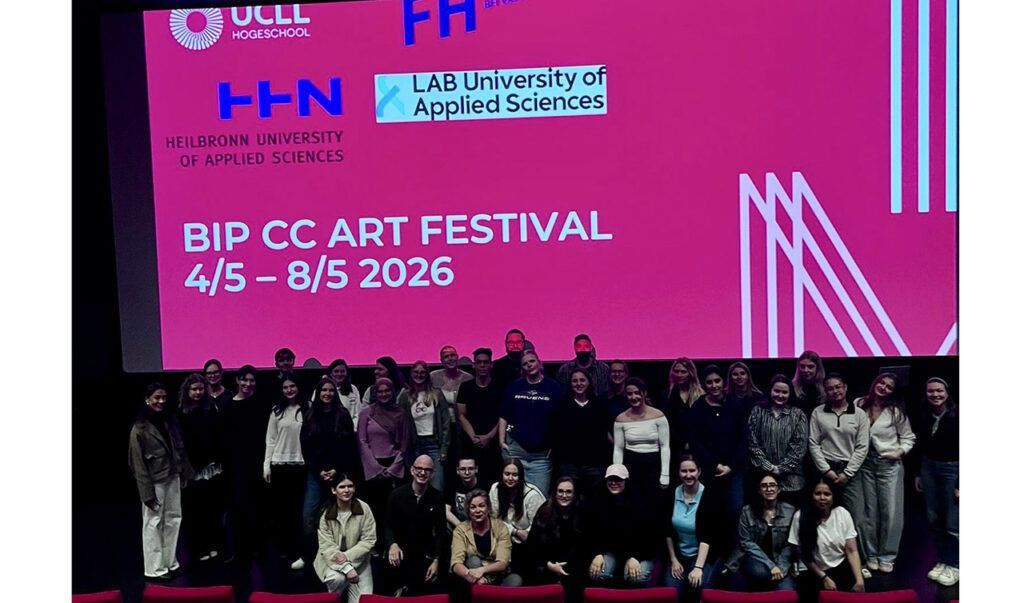
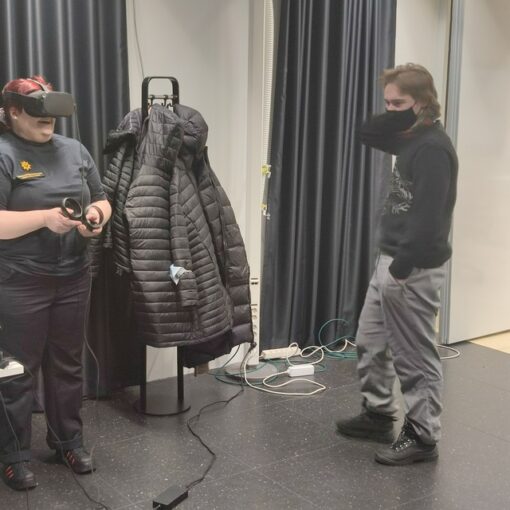
The exchange week is where planning turns into action. Students implement their projects on campus, working under real constraints such as time, space, resources, and audience expectations. Organizing an artistic event in a multicultural and multidisciplinary environment is demanding. It requires decision-making, negotiation, adaptability, and accountability. There are no simulated clients and no hypothetical outcomes, whether the idea works or it does not.
Teamwork as a core learning outcome
A key principle agreed upon within the teaching team is the balance between student autonomy and responsibility. Students are given genuine ownership of their work, and with it, real accountability. Teamwork is therefore essential, not optional.
This year, internal team challenges emerged clearly for the first time as a shared theme. These challenges highlighted the realities of working in multicultural and multidisciplinary environments and reinforced the idea that collaboration itself is one of the most important learning outcomes of the course.
One of the most significant challenges was the surfacing of underlying tensions within teams and the articulation of authentic individual experiences. It was observed that expressing personal perspectives was not always straightforward, despite its importance for fostering mutual understanding. Attention was drawn to the different ways in which communication styles are experienced by individuals, and to how these differences can either support or hinder effective collaboration.
Furthermore, it was noted that challenges related to team functioning were, on several occasions, communicated to instructors rather than being addressed directly within the team. This suggests that further development is needed in establishing open, constructive, and dialogical communication practices. Strengthening trust and encouraging direct interaction are therefore identified as key areas for improving future team collaboration.
Why this matters
CC Art Festival represents a hands-on approach to international education. It combines blended learning, teamwork, and creative production into one intensive experience. Students do not simply learn about collaboration; they practice it daily across cultures and professional boundaries. Team development is not a straightforward process (Orpana 2025), but an evolving journey that requires continuous interaction, adaptability, and shared understanding.
This is not passive learning. It is applied, shared, and lived.
Author
Taina Savonen is a Senior Lecturer at LAB University of Applied Sciences and is a founder member of the CC Art Festival as part of a multicultural and multidisciplinary teacher cohort.

References
Orpana, T. & Saros, H. 2022. Ideasta monialaiseen ja kansainväliseen konseptiin – CC Art Festival. Blog. LAB Focus. Cited 25 May 2026. Available at https://blogit.lab.fi/labfocus/ideasta-monialaiseen-ja-kansainvaliseen-konseptiin-cc-art-festival/
Orpana, T. 2025. Onnistunut tiimiytyminen kehittää kansainvälistymisen kokemusta. Blog. LAB Focus. Cited 25 May 2026. Available at https://blogit.lab.fi/labfocus/onnistunut-tiimiytyminen-kehittaa-kansainvalistymisen-kokemusta/