Generative AI has entered higher education at a pace that neither teachers, institutions, nor regulators can keep up with. Should universities seek to find more stringent control mechanisms for AI use, or learn to comply with a rapidly evolving technology that has already reshaped how students learn, do assignments and how knowledge is produced? These were among the central questions at the 20th ATINER Annual International Conference on Sociology, 4–8 May 2026, in Athens, Greece, where a less-surprising theme dominated the conversations and presentations: what does the rise of generative AI mean for academic integrity and knowledge itself?
Playing catch with AI
Not all voices were welcoming AI. Aarushi Bhandari, Assistant Professor at Davidson College (USA) claimed that AI has diminished the intrinsic motivation of students. When the effort of writing an essay can be offloaded to a chatbot, students are deprived of the cognitive struggle through which deep learning occurs. Her research pointed to mindfulness practices as effective counter-interventions that reduce the gratification students feel when delegating intellectual work to AI (Bhandari 2026). Her position was stark: as undergraduates fundamentally need to learn how to write and how to think, AI should be banned from them.
Professor Jose Manuel Castillo Lopez of the University of Granada (Spain) brought a sharp edge to the conversation in his keynote on the challenge of detecting and claiming fraud. He listed the difficulties sophisticated AI has introduced, beginning with the near-impossible task of detecting whether written or analytical work was produced with AI assistance. Then comes the thorny ethical dilemma of how to cite AI use, followed by the unresolved question of where to draw the line between legitimate AI assistance and academic dishonesty. He compared it with his own days as a young undergrad when it was forbidden to use a calculator to do math in the economics class (Castillo Lopez 2026). His talk underlined a seismic shift that institutions built on centuries of assumptions about individual authorship are experiencing as they are confronting a tool that can mimic both knowledge and its creator.
Simplified skills, complex problems
In her keynote, professor Parisa Gazerani of Oslo Metropolitan University (Norway) observed how university students are increasingly less interested in traditional degrees and more drawn to specific, high-value skills that can quickly enable them to master a technology or launch a successful startup. Such competencies are not necessarily taught in traditional universities where a degree consists of lot of other things students don’t find as immediately useful (Gazerani 2026).
Yet here lies the paradox. As demand grows for narrow specialization, the complexity of the world, amplified by AI, generates what Gazerani described as wicked problems. These challenges have no single, clean solution but would require broad systemic thinking and cross-sectoral collaboration (Gazerani 2026). The risk is that a generation trained (and motivated) for hyper-specialization for current world needs may lack the intellectual breadth to tackle precisely the civilizational challenges that most urgently need solving.
Universities caught in between
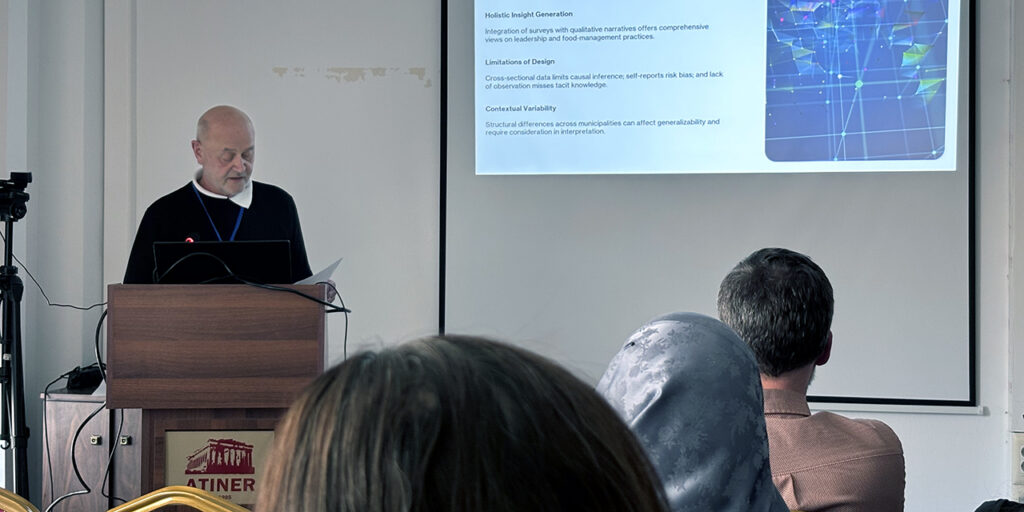
Palle Larsen, Senior Researcher at UCL University College (Denmark) argued that institutions of higher education are navigating an extraordinarily complex pressure landscape, simultaneously balancing demands for research excellence, high-quality teaching with quick graduation, societal impact, financial stability, and rapid digital transformation. Competitive funding systems and expanding administrative requirements are reshaping research priorities, raising profound concerns about academic autonomy and the long-term sustainability of knowledge creation.
Larsen’s blunt realization was that teachers can no longer keep up with students’ AI use. Rather than responding with blanket restrictions or more AI detection tools which rarely keep up with other AI tools outsmarting the detectors, he called for a fundamental pedagogical rethink. Universities should move away from traditional knowledge-transfer models towards cultivating critical thinking, ethical reasoning, and the kind of human judgement AI cannot replicate. As AI cannot be deflected, we need more AI-savvy youth for it to become a tool for actual gains. (Larsen 2026.)
Whether AI should be embraced or regulated in higher education, it is already reshaping the conditions under which knowledge is produced, taught, and evaluated. These are not merely technical questions but ethical, and deeply human ones.
Author
Ari Hautaniemi works as an RDI Specialist at the LAB Institute of Design and Fine Arts. He is part of the Design for Futures research group.
References
Bhandari, A. 2026. ‘Teaching Intrinsic Motivation in a Time of Artificial Intelligence: Can Mindfulness Help?’, paper presented at the 20th Annual International Conference on Sociology, ATINER, Athens, 5 May 2026.
Castillo Lopez, J.M. 2026. ‘The Challenge that Artificial Intelligence Poses to Traditional Research and Teaching Objectives and Methods: The Perspective of Fraud’, paper presented at the 20th Annual International Conference on Sociology, ATINER, Athens, 5 May 2026.
Gazerani, P. 2026. ‘Rethinking Universities in an Era of Complexity’, keynote presented at the 20th Annual International Conference on Sociology, ATINER, Athens, 5 May 2026.
Larsen, P. .2026. ‘Universities Face a Complex and Evolving Pressure Landscape’, paper presented at the 20th Annual International Conference on Sociology, ATINER, Athens, 5 May 2026.