The European Union is committed to becoming carbon neutral by 2050 (European Comission). At the same time, the impacts of climate change are already visible in many parts of Europe. However, different regions are at varying stages in terms of mitigation and adaptation efforts. During spring 2026, the ClimateGO project partners had the opportunity to explore the situations in two European cities: Alzira in Spain and Waterford in Ireland.
Both cities share a focus on sustainable mobility and the creation of a pleasant urban environment
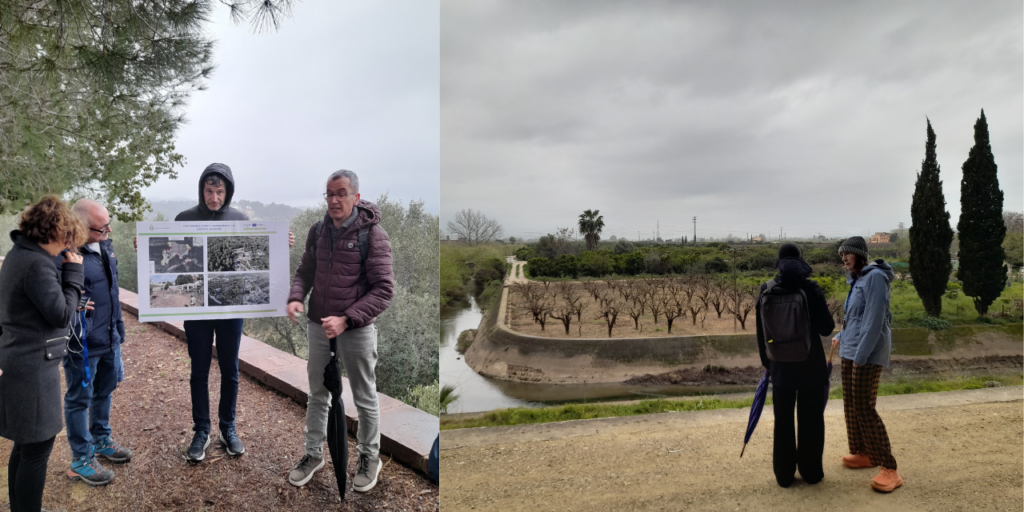
Alzira is a city located in Valencia, eastern Spain. So far, the city has experienced all the major climate change–related risks, ranging from wildfires and suffocating heatwaves to storms and flooding. The most devastating event so far was the flash floods in October 2024, following heavy rainfall caused by the climate change–amplified DANA phenomenon, resulting in significant loss of life and widespread damage to infrastructure. As a result, the city’s focus is on risk management, adaptation, and resilience, as we observed while exploring the work of the city administration and its numerous reconstruction projects.
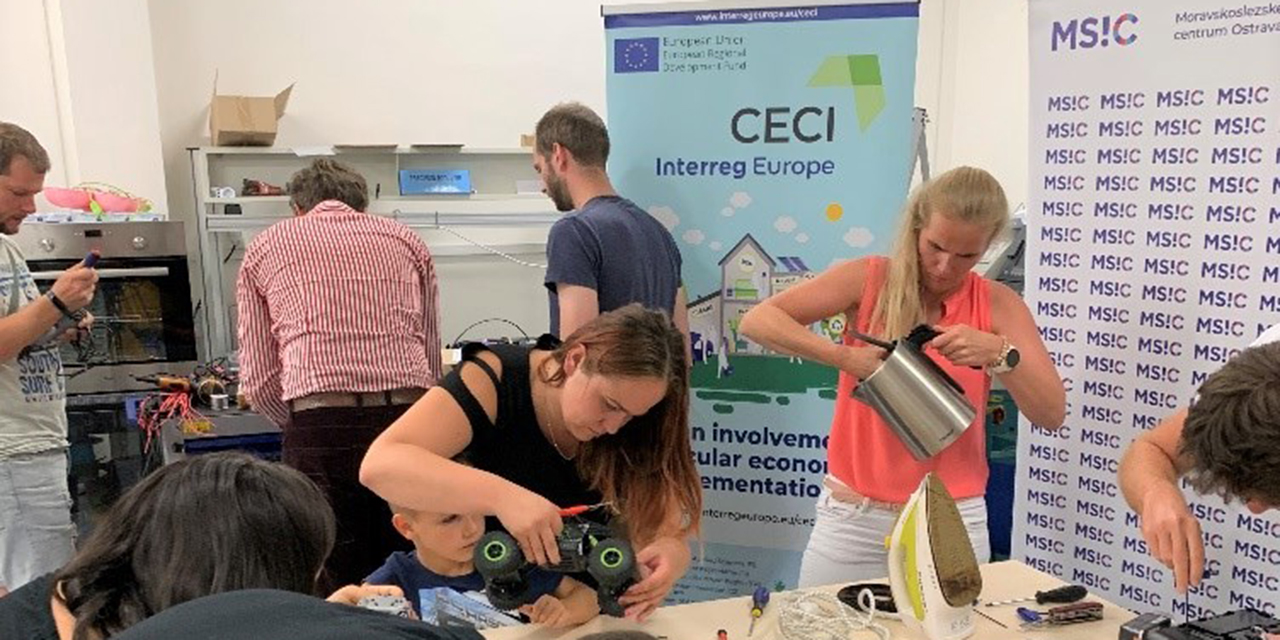
In our other case study location, Waterford, the impacts of climate change are not yet clearly visible in everyday life. The main emphasis of climate action lies on overall sustainability, while nature-based solutions for climate adaptation and the expansion of urban green spaces are only beginning to gain momentum. However, climate action has gathered pace rapidly, and Waterford has already seen the launch of a range of practical initiatives from knitting groups and youth film festivals to paint and bicycle recycling schemes and community gardens.
In both locations, a shared priority was the pursuit of co-benefits. Alongside climate mitigation and adaptation, efforts were also directed at improving the quality and attractiveness of public spaces, safeguarding cultural heritage, and promoting sustainable mobility.
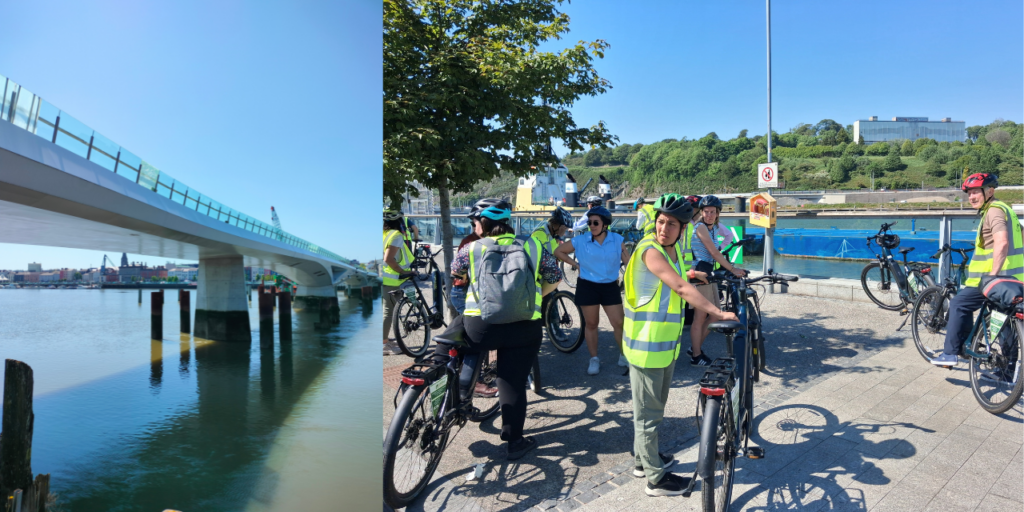
Private car use remains the dominant mode of transport in both cities, yet efforts have been made to strengthen opportunities for active mobility. In Alzira, a cycling-friendly green belt has been created around the city, while in Waterford, a ‘Green Route’ runs through the city, complemented by a pedestrian and cycling bridge that will connect its northern and southern parts by the end of the year.
Key takeaways from the perspective of Päijät-Häme region
The meeting in Alzira highlighted the importance of risk management, adaptation, and resilience, as well as the need for decisive leadership and strong commitment from decision-makers. It also underscored the value of cross-sectoral collaboration in enabling integrated and long-term solutions.
In Waterford, rapid progress has been achieved despite a modest starting point. Clear decisions and strategic investments have advanced sustainable mobility and major infrastructure projects.
The key takeaway is that a decisive direction matters. With a shared vision and well-prepared plans, it is easier to secure funding and implement impactful, large-scale projects. Combining initiatives can further enhance their benefits, as demonstrated by Waterford’s coordinated infrastructure developments.
A site visit to the social enterprise GIY highlighted the role of local food production in promoting health, sustainability, and resilience. Supporting people to grow their own food strengthens local food security and reduces dependence on long supply chains. (Grow HQ 2026)
In Päijät-Häme, climate work has long been addressed at the strategic level and work is guided through the Green Transition Programme (Regional Council of Päijät-Häme 2024) and a Climate Change Adaptation Plan (Regional Council of Päijät-Häme 2023). However, challenges lie in how to convert these strategies into concrete actions. Experiences from Alzira and Waterford show that clear direction and strong commitment enable rapid implementation. More bold experiments in circular economy, food, and mobility are needed, with the aim of scaling them into larger solutions over time. Action can start, for example, with community gardens, promoting cycling-friendly routes, and other grassroot activities – solutions from both cities that are easily scalable to Päijät-Häme as well.
Authors
Maarit Virtanen works as a Project Manager in the Regional Council of Päijät-Häme. Her work focuses on climate change adaptation and sustainability.
Marjut Villanen works as an RDI specialist at LAB University of Applied Sciences. In ClimateGO project she works as a project manager promoting the achievement of the project’s goals.
Hanna Suutari works as an RDI Specialist at LAB University of Applied Sciences. In ClimateGO project she fosters climate-smart dialogue through communication.
References
European Comission. 2050 Long term strategy. Cited 4 Jun 2026. Available at https://climate.ec.europa.eu/eu-action/climate-strategies-targets/2050-long-term-strategy_en
Grow HQ. 2026. Inspired by Our Farm – A GIY Story? Cited 5 Jun 2026. Available at https://giy.ie/
Regional Council of Päijät-Häme. 2023. Päijät-Hämeen ilmastonmuutoksen sopeutumisen suunnitelma 2023–2030. Päijät-Hämeen liitto A260. Cited 20 May 2026. Available at https://paijat-hame.fi/wp-content/uploads/2023/05/220523Ilmastonmuutoksen_sopeutumisen_suunnitelma_2023-2030.pdf
Regional Council of Päijät-Häme. 2024. Green transition programme for Päijät-Häme. Päijät-Hämeen liitto A264. Cited 20 May 2026. Available at https://paijat-hame.fi/wp-content/uploads/2024/06/280624_Green_transition_programme_for_PH_web.pdf