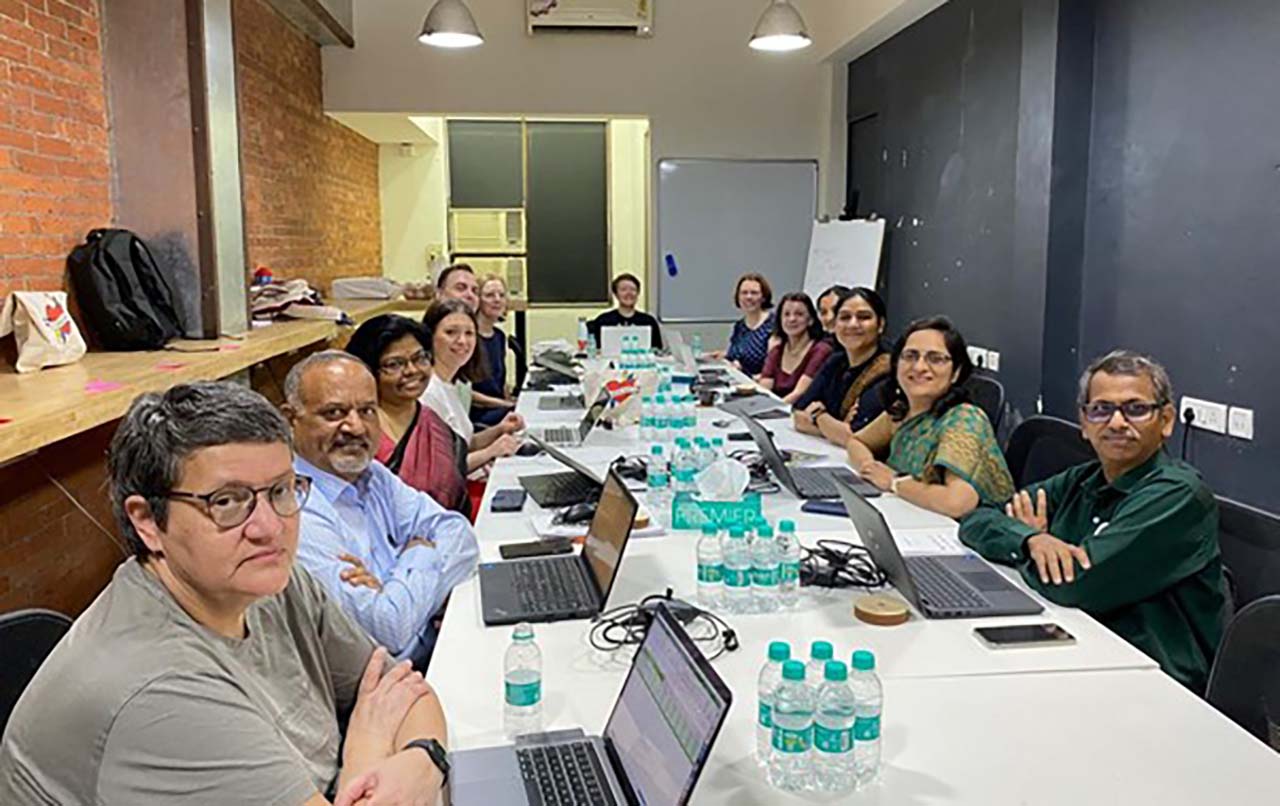
Global teams are the norm today, and cultural misunderstandings are increasingly common. How should leaders respond when, say, an Indian employee sees a French colleague as rigid and inflexible, while a British employee finds the same colleague as disorganized and untimely? (Meyer 2022).
The culture map framework
Geert Hofstede’s Cultures and Organizations: Software of the Mind (1991) laid the groundwork for cultural analysis, Hofstede being a pioneer in the field. His work was followed by Fons Trompenaars’ Riding the Waves of Culture: Understanding Diversity in Global Business (1998). Both have since written several works on the topic. Building on their work and her own research, Erin Meyer, professor at INSEAD business school has continued studying cultural behavior patterns and has further developed these models into a more practical framework. (Hofstede 1991; Trompenaars 1998; Meyer 2014). She helps international leaders decode cultural behaviour and offers practical tools to manage cultural differences effectively.
Meyer’s Culture Map Framework breaks culture down into 8 behavioral scales, focusing specifically on behaviors in business. These eight scales are Communication, Evaluation, Leading, Deciding, Trusting, Disagreeing, Scheduling, and Persuading. With 180,000 interviews in 62 different countries, Meyer mapped different cultures on these behavioral scales. By analyzing a country’s position on a scale in relation to another, the dimensions enable us to decode how culture influences any international collaborations. (Meyer 2014; 2022).
Two practical examples: evaluation and trusting
Giving and receiving negative feedback can often lead to significant challenges and even break relationships. In the Culture Map Framework, the Evaluation dimension analyses differences in giving negative feedback. Cultures vary widely in how directly they deliver negative feedback and how much negative feedback should be balanced with positive feedback. In some countries, negative feedback is given directly and bluntly, when employees from other countries find the same feedback offensive and rude, harming employee relationships. A general tip for leaders working with unfamiliar cultures is to begin by giving negative feedback in a softer, less direct manner, and only gradually introduce more direct feedback if it is something the leader wishes to implement. This reduces the risk of damaging trust, which can easily be lost if employees feel offended by overly harsh criticism. (Meyer 2014).
The Trusting dimension of the framework discovers the differences between task-based trust and relationship-based trust cultures (Meyer 2014). In task-based trust cultures, employees build mutual trust by working together and relying on each other’s performance. For people from relationship-based trust cultures, developing personal relationships that extend beyond job performance is valued and it plays a vital role in working relationships. However, in many other cultures, trust develops through personal connections beyond work. For leaders, making an effort to form relationships not tied to job performance is essential, especially when working with people from different cultures. Setting up a dinner or investing in personal team building builds trust and makes a huge difference in preventing and solving future possible mistakes or conflicts (Hawk 2021).
These two examples introduce just a few of Meyer’s behavioral dimensions and general suggestions for leaders that Meyer explores in greater depth in her framework.
Continuously evolving cultures
Real leaders recognize that with cultural principles, we never stop learning. Understanding cultural norms can help leaders pinpoint which traits of individual international employees might be cultural and which are personal (Hawk 2021). The importance of understanding this has only increased because of the increase in working with single international individuals and multicultural teams. The new working generation, Generation Z, demands leadership that is emotionally intelligent and understanding, which further increases the need for leaders to understand their employees nationally and internationally (Halonen 2025). For leaders wanting to build a base of understanding cultural behavioral differences, the Culture Map is a great tool for improving international leadership skills.
Authors
Milla Halonen is a Bachelor of Business Administration, having studied International Business at LAB University of Applied Sciences.
Sanna Kokkonen works as a senior lecturer for multicultural groups at LAB University of Applied Sciences.
References
geralt. 2018. Altmann, G. Sosiaalinen media, digitalisointi. Pixabay. Cited 19 Feb 2026. Available at https://pixabay.com/fi/illustrations/sosiaalinen-media-digitalisointi-3271590/
Halonen, M. 2025. Resilience in multicultural Generation Z employees. Bachelor’s thesis. LAB University of Applied Sciences. Cited 2 Oct 2025. Available at https://urn.fi/URN:NBN:fi:amk-2025100725695
Hawk, R. 2021. Erin Meyer – How To Build A High Performance Culture | The Learning Leader Show With Ryan Hawk. YouTube video. Cited 2 Oct 2025. Available at https://youtu.be/r3V5ygNLVHA?si=z6E5xr8Tvr6JjM_T
Hofstede, G. 1991. Cultures and Organizations: Software of the Mind. London: McGraw-Hill. Cited 2 Oct 2025. Available at https://www.mheducation.com
Meyer, E. 2014. The Culture Map: Breaking Through the Invisible Boundaries of Global Business. New York: PublicAffairs. Cited 2 Oct 2025. Available at https://www.publicaffairsbooks.com
Meyer, E. 2022. Lead, Negotiate, and Get Things Done Across the World. Presentation at Nordic Business Forum 2022, Helsinki.
Trompenaars, F. 1998. Riding the Waves of Culture: Understanding Diversity in Global Business. New York: McGraw-Hill. Cited 2 Oct 2025. Available at https://www.mheducation.com