Attention Deficit Hyperactivity Disorder (ADHD) is receiving increasing attention in modern society. It is discussed both in private conversations and publicly in society across the globe. Increased knowledge and awareness by healthcare professionals leads to early detection and, as a result, there has been a growing number of diagnoses in all age groups.
ADHD is a neurodevelopmental disorder with symptoms that can negatively impact the daily life of an individual. The core ADHD symptoms include inattention, hyperactivity, and impulsivity. These types of symptoms interfere with academic performance, social and emotional functioning of individuals. (National institute for health and care excellence 2019.) According to statistics from Finland, approximately 11 % of boys and 4 % of girls of primary school age are diagnosed with ADHD. Among young people aged 13 to 17, approximately 10 % of boys and 6 % of girls have an ADHD diagnosis. (Finnish Institute for Health and Welfare 2025.)
Medication is often recommended as a primary treatment for ADHD by physicians around the globe. The efficacy of the pharmacological interventions for ADHD was demonstrated in various peer-reviewed publications. Psychostimulants (methylphenidate, dexamphetamine, mixed amphetamine salts and lis-dexamphetamine) and non-psychostimulants (atomoxetine) have been studied the most extensively and their effectiveness was found and supported by repeated research trials. Overall, non-pharmacological therapies are seen as a supplemental treatment. However, the evidence of its effectiveness in combination with medication is growing. (De Crescenzo et al. 2017; Firn & Pekshieva 2026)
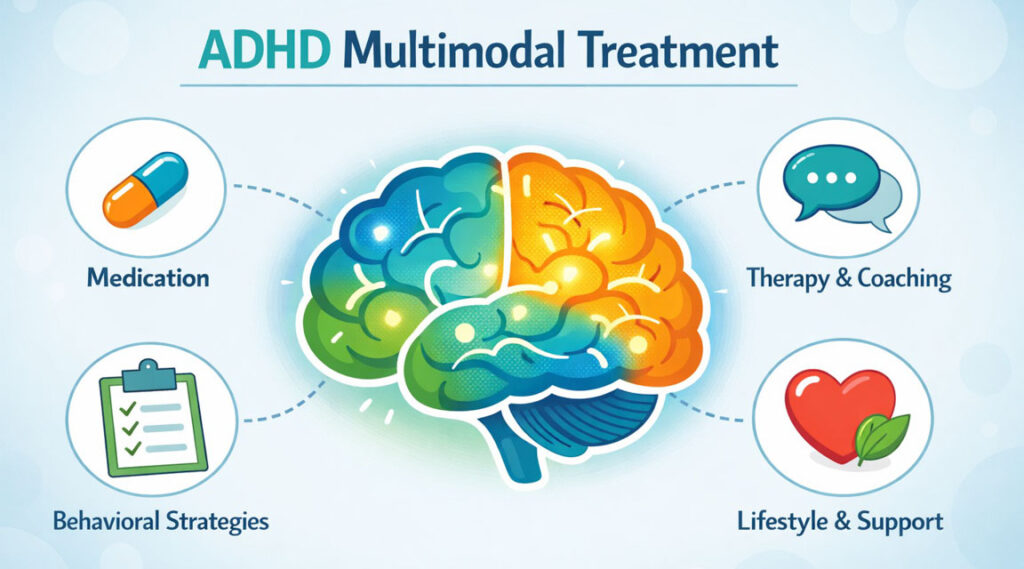
Non-pharmacological interventions supporting holistic care
There are several non-pharmacological treatment forms which are recommended together with ADHD medication: Cognitive Behavioural Therapy (CBT), Mindfulness-based interventions (MBI) and Applied Behavior Analysis (ABA).
CBT is a form of psychotherapy that was demonstrated to be effective not only on core ADHD symptoms (inattention, hyperactivity and impulsivity), but also on emotional symptoms, such as irritability, low self-esteem and anxiety. CBT techniques help individuals to replace the negative-thinking patterns with positive ones and improve self-confidence and control irrational thinking. (Liu et al. 2023.)
The main MBI meditative techniques are body scanning, sitting meditation, and mindful yoga. The practice encourages present in-the-moment non-judgmental observation and acceptance of one’s own feelings, thoughts, and sensory perception which may lead to reduced impulsivity, better concentration and emotional regulation. In addition, reduced anxiety improves the sleep patterns and general well-being. (Poissant et al. 2019.)
ABA uses interventions which help to increase desired skills and behaviours and reduce undesired behaviors that interfere with everyday functioning. The most common interventions are positive reinforcement, shaping techniques, token economies, modelling and task-analyses. When applied in classroom settings, ABA procedures improve attention problems, prolong on-task behavior, reduce motor and verbal hyperactivity. (Staff et al. 2021.)
Best results are gained with combined treatment
Overall, managing ADHD effectively is a holistic process. Medication reduces the main ADHD symptoms and, in many cases, increases functional capacity. However, medication does not work without non-pharmacological interventions. Therefore, understanding individual needs is crucial for choosing correct care interventions. Whichever method is chosen, it is certain that a multimodal approach is more effective, leading to a better quality of life for individuals with ADHD.
Authors:
Kira Pekshieva is a graduate nursing student at LAB University of Applied Sciences. She has done her bachelor’s thesis on pharmacology and effects of ADHD medication.
Sini Hämäläinen works as a senior lecturer at LAB University of Applied Sciences. She is a part of the Diverse and Inclusive Working Life -research group.
References
De Crescenzo, F., Cortese, S., Adamo, N., & Janiri, L. 2017. Pharmacological and non-pharmacological treatment of adults with ADHD: a meta-review. Evidence-based mental health, 20(1), 4–11.
Finnish Institute for Health and Welfare. 2025. ADHD diagnoses among children and young people continue to increase – regional differences are still significant, but gender differences are narrowing.
Firn, M. & Pekshieva, K. (2026) Pharmacology and effects of stimulant medication on children and adolescents with ADHD and their development. Bachelor’s thesis. LAB University of Applied Sciences. Available at: https://urn.fi/URN:NBN:fi:amk-202604136279
Liu, C. I., Hua, M. H., Lu, M. L., & Goh, K. K. 2023. Effectiveness of cognitive behavioural-based interventions for adults with attention-deficit/hyperactivity disorder extends beyond core symptoms: A meta-analysis of randomized controlled trials. Psychology and psychotherapy, 96(3), 543–559.
National Institute for Health and Care Excellence. 2019. Guidance. Attention deficit hyperactivity disorder: diagnosis and management.
OpenAI. 2026. ADHD multimodal approach [AI-generated image]. https://chat.openai.com
Poissant, H., Mendrek, A., Talbot, N., Khoury, B., & Nolan, J. 2019. Behavioral and Cognitive Impacts of Mindfulness-Based Interventions on Adults with Attention-Deficit Hyperactivity Disorder: A Systematic Review. Behavioural neurology, 2019, 5682050.
Staff, A. I., van den Hoofdakker, B. J., van der Oord, S., Hornstra, R., Hoekstra, P. J., Twisk, J. W. R., Oosterlaan, J., & Luman, M. 2021. Effectiveness of Specific Techniques in Behavioral Teacher Training for Childhood ADHD: A Randomized Controlled Microtrial. Journal of clinical child and adolescent psychology: the official journal for the Society of Clinical Child and Adolescent Psychology, American Psychological Association, Division 53, 50(6), 763–779.