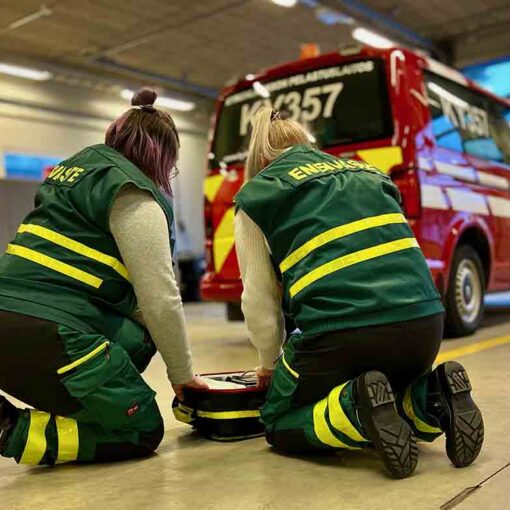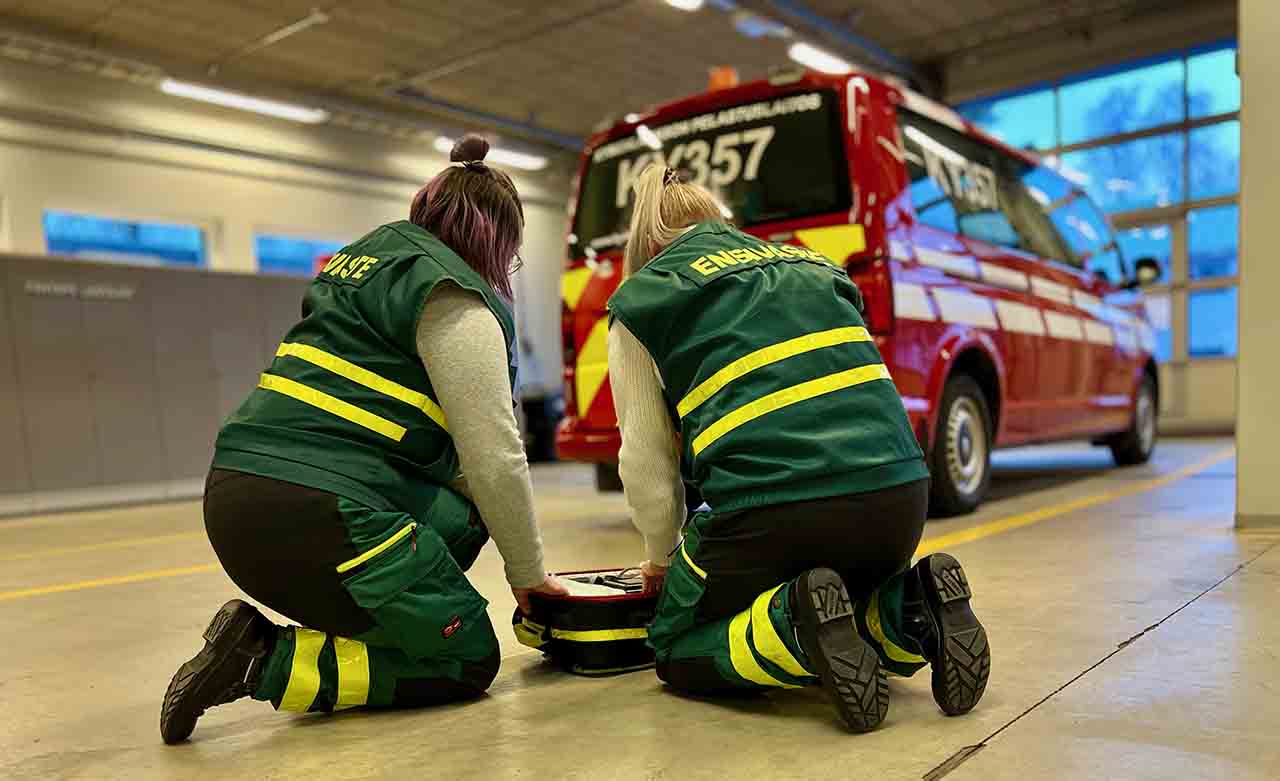
The number of maternity hospitals in Finland has decreased from 41 to around 21 from the turn of the century, leading to longer distances to access maternity care and an increased risk of out-of-hospital births (YLE 2025). This development has a direct impact on the work of paramedics since they are the ones taking care of missions related to out-of-hospital births, and they must now attend more births outside hospitals due to the growing distance to maternity wards. Furthermore, the current paramedic training does not adequately prepare current and future paramedic professionals to manage births in the emergency field. (Farah Abdi et al 2025).
Increase in out-of-hospital deliveries increases the need for information and understanding of how paramedics can better prepare for such situations. Understanding both routine procedures and emergency care is essential to ensure the safety of the mother and newborn in births outside of hospitals. (Hill et al. 2023; Farah Abdi et al. 2025)
![[Alt-teksti: an ambulance outside with nature and finnish flags behind it.]](https://blogit.lab.fi/labfocus/wp-content/uploads/sites/8/2026/04/LAB-FOCUS-176_2026_Paramedics-in-frontline-of-a-growing-challenge_-increased-out-of-hospital-births.jpg)
Risks associated with out of-hospital deliveries
Delivery situations depend on whether birth progresses normally. A normal delivery can be divided into three stages: the dilation phase, pushing phase, and the final phase where the placenta and the fetal membranes are delivered. Risks can appear at all stages of delivery. In the case of a normal full-term pregnancy, the paramedics’ mission is to assist in the delivery and ensure that both the mother and baby are safe. Paramedics must be able to recognize the normal labor process and possible challenges related to it, such as, whether the pregnancy is full-term, the baby is head-first, whether it is a first birth, and how to assist with the delivery. With this knowledge, the paramedics can act appropriately and keep the situation under control before reaching the closest maternity unit. (Tiitinen 2023; Saisto 2024; Farah Abdi et al. 2025.)
With the closure of maternity units in smaller towns, many expectant mothers, especially in rural areas, are forced to travel long distances to receive appropriate care. This delay poses serious health risks to both mothers and newborns. (Hill et al., 2023). Paramedics often feel inadequately prepared for out-of-hospital births due to limited training and lack of experience. However, they are expected to handle high-risk situations such as breech births, shoulder dystocia, severe bleeding, or cord prolapse situations that, if performed in a hospital setting, would require the presence of a doctor or a midwife. Paramedic education touches these matters briefly, and simulated trainings are organized for both students and professionals in the field, but a small number of missions may lead to stress and uncertainty in real situations. (Beaird et al. 2023; Farah Abdi et al. 2025). This in turn leads to increased stress which can lead to burnout or even intentions to leave the field (Kipchirchir & Savi 2024).
Better training for paramedics would ensure safety of mothers and babies
As paramedics take on more responsibility for delivering babies, better training and updated protocols are needed. Decreasing additional stress and insecurity related to the missions can in turn affect the overall wellbeing of the paramedic staff. According to Farah Abdi et al (2025), it is extremely important to ensure the safety of both mothers and newborns to ensure that paramedics are prepared to deal with the common risks associated with childbirth. In Finland this is a matter which needs to be addressed when planning paramedic curricula as well as within health care organizations providing training to professionals in the field. With sufficient training and education, the changing work environment and new emerging missions can be handled with quality care and adequate competence, which in turn promotes overall safety of both the client(s) and staff.
Authors:
Sovin Anvar Khan Avdel is a graduate paramedic nursing student at LAB University of Applied Sciences. She did her bachelor’s thesis on out-of-hospital births in Finland and paramedic competences related to them.
Sini Hämäläinen works as a Senior Lecturer and researcher of Diverse and Inclusive Working Life – research group at LAB University of Applied Sciences
References
Anvar Khan Avdel, S. (2025). Picture of an ambulance.
Beaird, D., Ladd, M., Jenkins, S. & Kahwaji, C. 2023. EMS prehospital deliveries. Retrieved on 26.09.2025. Treasure Island (FL): StatPearls Publishing. Available at: https://www.ncbi.nlm.nih.gov/books/NBK525996/
Farah Abdi, A., Anvar Khan Avdel, S., Karjalainen, N. 2025. The impact long distances on pre-hospital care for birth related complications. Thesis. LAB University of Applied Sciences. Retrieved on 24.09.2025. Available at https://urn.fi/URN:NBN:fi:amk-2025050810030
Hill, M., Flanagan, B., Hansen, S., Hopper, L. & Mills, B. 2024. Out-of-hospital birth training, experience and confidence of Australian rural volunteer ambulance officers. Retrieved on 26.09.2025. Available at 10.22605/RRH8788
Kipchirchir, D. & Savi, H. 2024. Burnout among paramedics and how it affects the quality of care: narrative literature review. Bachelor’s thesis. LAB University of Applied Sciences. Retrieved 27.10.2025. Available at: https://urn.fi/URN:NBN:fi:amk-2024120433094
Saisto, T. 2024. ’Synnytyksen kolmas vaihe eli jälkeisvaihe’, Lääkärikirja Duodecim. Retrieved on 20.11.2025. Available at https://www.terveyskirjasto.fi/dlk01376
Tiitinen, A. 2023. Normaali synnytys. Lääkärikirja Duodecim. Retrieved on 24.11.2025 Available at https://www.terveyskirjasto.fi/dlk00160
Yleisradio (YLE) 2025. Synnytyssairaaloiden määrä on puolittunut, osa niistä ruuhkautunut ajoittain. Retrieved on 26.09.2025. Available at https://yle.fi/a/74-20172844